Manufactured at Origin.
Specified by You.
An Indonesian coconut coir manufacturer running its own production line in Central Sulawesi.
Palu · Central Sulawesi · Indonesia
The Manufacturer's Edge
Why B2B buyers source directly from us.
Direct Source
No middlemen or trading layers. We collect the husk, run the production line, and ship directly from our Palu facility to ensure competitive pricing and accountability.
Absolute Control
Every block runs through a strict sequence with dedicated measurement points. We control the washing, buffering, and pressing stages internally.
Your Specification
Your market dictates the requirements. We tailor particle sizes, conductivity (EC) limits, and expansion ratios to fit your exact operational needs.
A manufacturer built around control, consistency, and specification.
We do not just trade coconut coir; we produce it. Operating our own manufacturing facility in Palu, Central Sulawesi, allows us to maintain strict internal controls over the entire process. From raw coconut husk intake to compressed cocopeat blocks, our focus is singular: meeting the exact specifications required by international buyers.
Read Full Story →
"The specification belongs to the buyer.
The execution belongs to us."
Production at a glance
One line, two grades, your spec.
Both grades come off the same controlled line. Formed to buyer specification on request.
Grade A
Low EC · Propagation
- Particle size 0–6 mm
- EC (1:1.5) < 0.5 mS/cm
Grade B
Graded · Growing Media
- Particle size 0–20 mm
- EC (1:1.5) < 0.8 mS/cm
A manufacturer built around control, consistency, and specification.
PT Astra Askara Adiluhung is a dedicated producer of coconut coir running our own production line directly in Palu, Central Sulawesi. We are not a trading house; we are the facility that processes the raw material.
By sourcing coconut husk locally and controlling the entire manufacturing process in-house, we transform raw byproduct into high-quality, compressed cocopeat blocks. Our operation is engineered specifically to meet the stringent requirements and specifications of international B2B buyers.
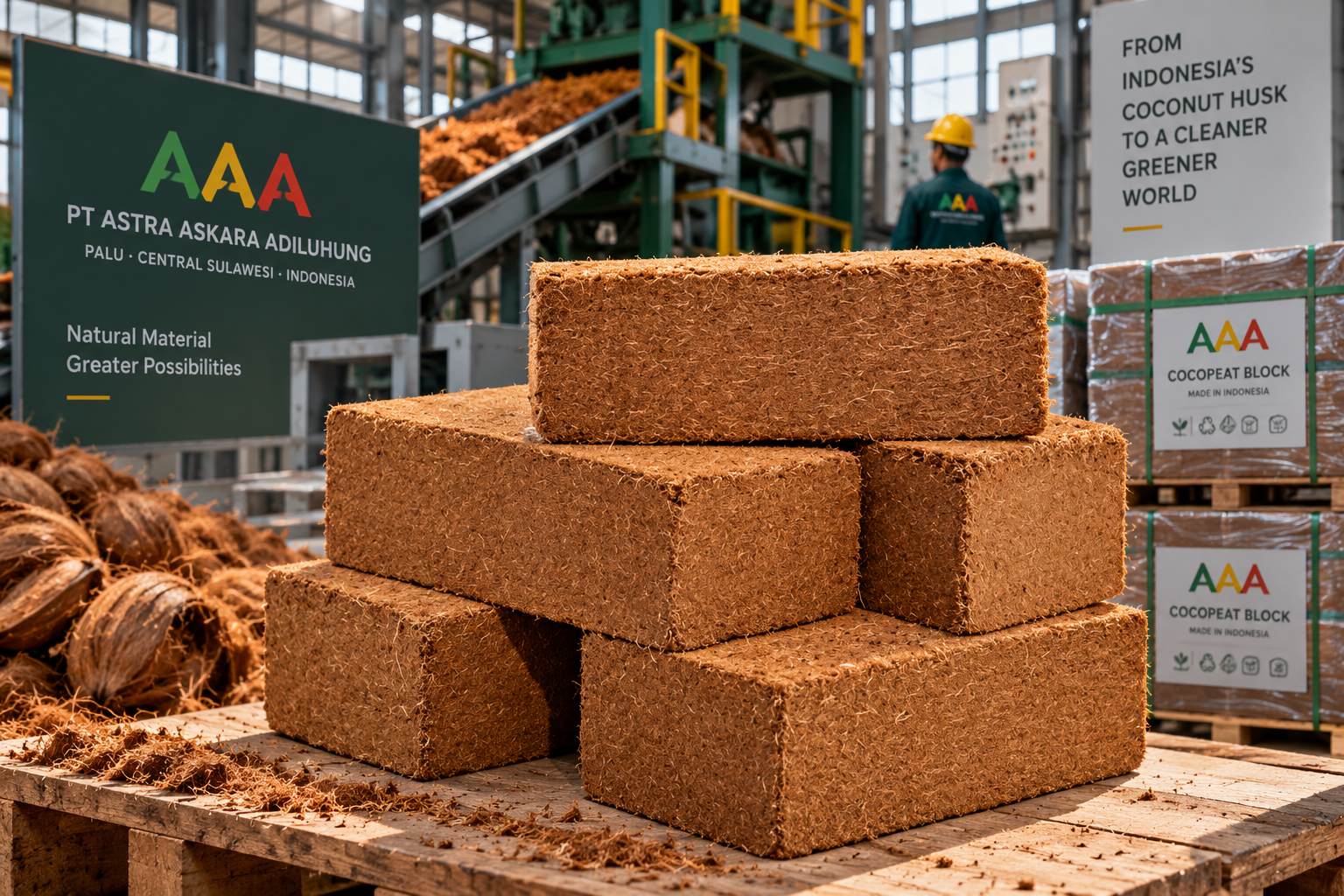
Palu, Central Sulawesi
The Facility
A plant we own,
in the coconut belt.
Husk arrives from collectors within the region. It leaves as palletised blocks. Everything between those two points happens under one roof and one set of controls.
Site Area
10,000 m²
Line Rate
1 t/hr
Operating Hours
24 / day
Grid Connection
415 kVA
Drying Fuel
Biomass
Sourcing & Sustainability
Sulawesi first,
the archipelago behind it.
Coconut husk is a byproduct. We collect it from smallholders across Central Sulawesi and pay for a material that previously had no buyer. Our sourcing approach is practical and rooted in regional utilization.
Byproduct Sourced
Repurposing agricultural material.
Regions
Network spanning Sulawesi, Sumatra, and Java.
Site
Manufacturing centralized in Palu today.
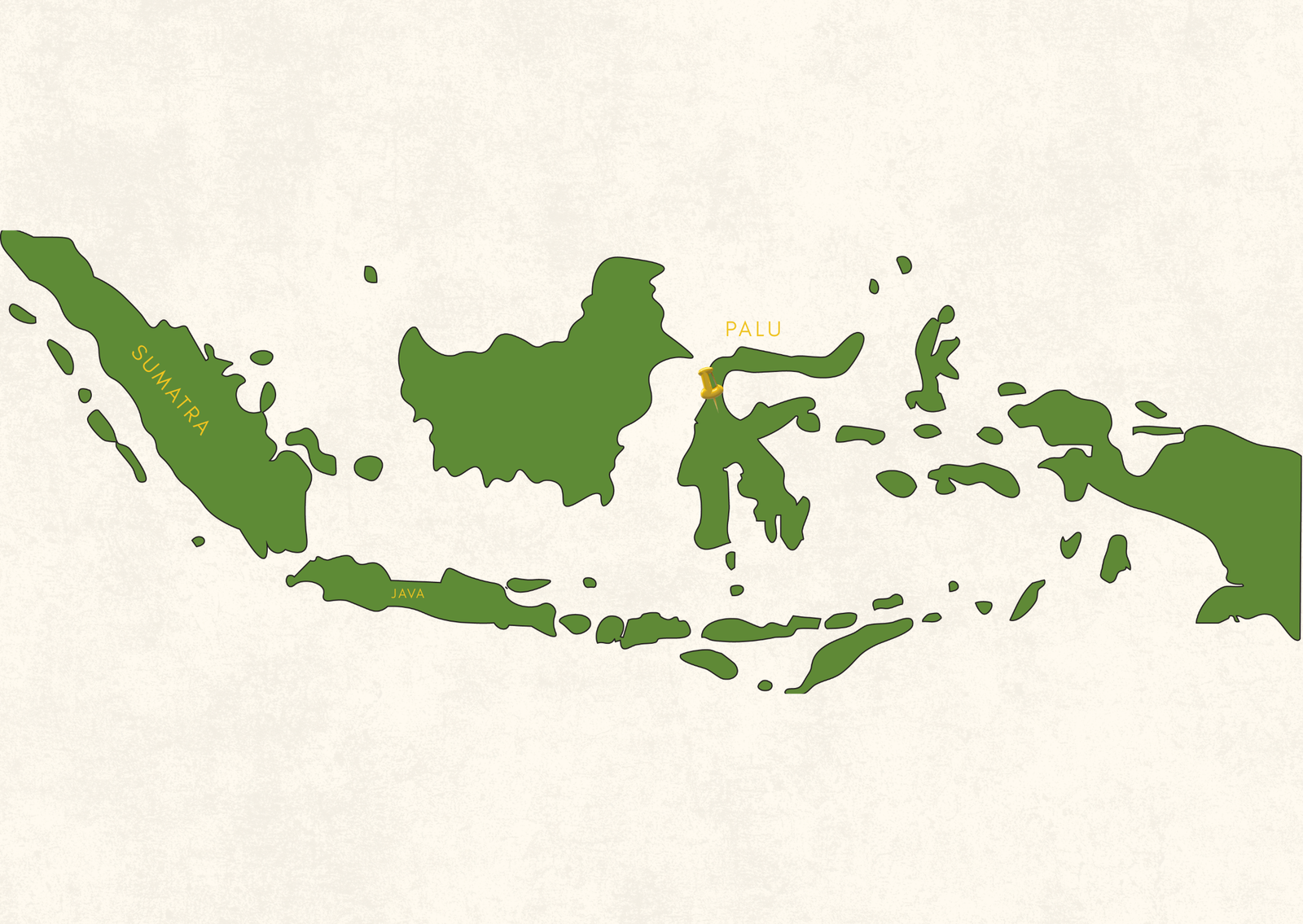
Indonesian Sourcing Network
Certification & Quality
Certification follows the buyer.
We do not publish a fixed list of certificates, because every market asks for a different one. Certification is part of the specification, and the specification belongs to the buyer.
Sold internationally through
Across Indonesian Seas.
AAA Manufactures
We collect husk, run the line, and stand behind the block that comes off the end of it.
AIS Sells
A Vancouver-based trading and logistics company handling international sales, documentation, and freight.
Visit AIS WebsiteThe Product
One line, two grades, your spec.
Both grades come off the same controlled line. Grade A is washed for propagation; Grade B is screened for general growing media. Both are formed to buyer specification on request.
Grade A
Low EC · PropagationIdeal Applications
Strictly washed to lower conductivity. Ideal for sensitive seed propagation, soft fruits (strawberries, blueberries), and precision hydroponic systems requiring a stable growing environment.
Grade B
Graded · Growing MediaIdeal Applications
Carefully screened to maintain natural structure. Excellent as a base component for potting soil mixes, landscaping, and general growing media requiring high aeration and water retention.
Format & Logistics
Palletised.
Shrink-wrapped.
Export-ready.
We understand that freight efficiency dictates your landed cost. Our blocks are heavily compressed, securely stacked on standardized pallets, and tightly shrink-wrapped to maximize payload inside standard international shipping containers.
5 kg
Standard Block Weight
30x30x15 cm
Uniform Dimensions
40ft HC
Optimized Loading
Palletized
For Forklift Handling
Ready for port dispatch handled by
Across Indonesian Seas
Beyond Cocopeat
One nut, more than one product.
Tell us the specification and volume, and we will tell you what we can supply now.
Cocopeat Blocks
Washed and graded coir pith, compressed to 5 kg export blocks.
Coir Fibre
Long fibre separated from the pith at screening.
Chips and Grow Bags
Chipped husk and filled bag formats to buyer dimensions.
Shell Charcoal
Shell-derived charcoal for filtration and fuel applications.
Process
Six stages, six control points.
Every block runs the same sequence. Each stage has a parameter and a point at which it is measured, ensuring consistent quality output aligned with buyer requirements.
Intake & Shredding
Raw coconut husk arrives from regional collectors. Initial visual inspection and shredding prepare the raw material for uniform processing, stripping away unsuitable debris.
Screening
Mechanical sieves separate long coir fibre from the pith. This stage is tightly controlled to achieve the exact particle size requested, whether 0-6 mm for Grade A or 0-20 mm for Grade B.
Washing & Buffering
A critical stage to reduce naturally occurring salts. The pith is thoroughly washed to bring electrical conductivity (EC) levels strictly below the 0.5 mS/cm threshold required for propagation grades.
Dewatering
Before entering the drying yard, excess water is removed through mechanical pressing. This ensures a consistent baseline moisture level before the thermal drying process begins.
Drying
Using dedicated biomass fuel, the pith is carefully dried to lower its moisture content. This prevents mold growth and achieves the precise moisture percentage required for maximum compression.
Pressing & Baling
The final material is hydraulically compressed into standardized 5 kg blocks. Machine settings are calibrated per buyer spec to guarantee a minimum expansion ratio of ≥ 15 L per kg.
Measured, not just claimed.
Quality at PT Astra Askara Adiluhung is a measurable metric, not a marketing promise. By operating our own production line under one roof in Palu, we ensure that every block leaving our facility precisely matches the exact parameters agreed upon with the buyer.
Next Step
Send us your target spec.
Dimensions, conductivity, particle size, moisture, format, volume. Send what your operation needs and we will tell you what the line can hold.